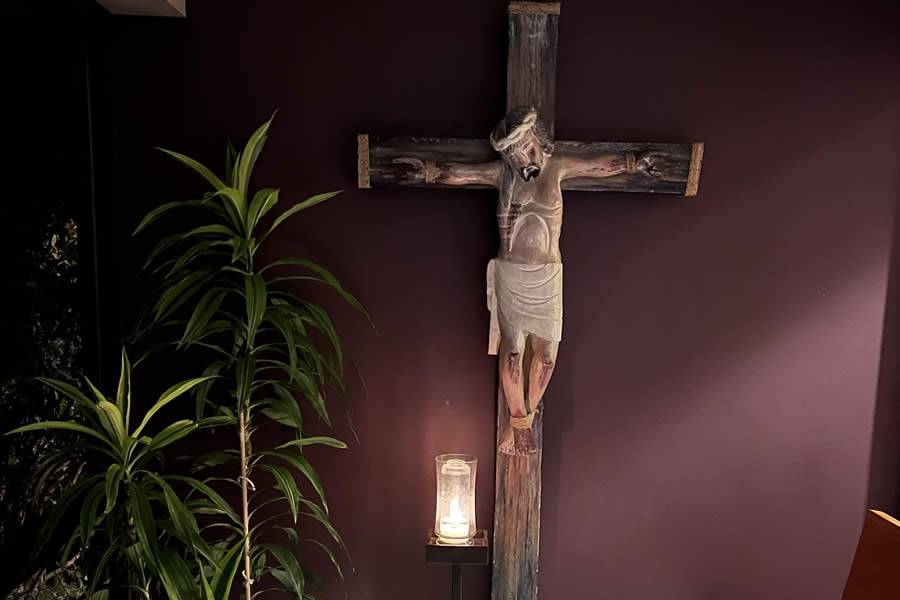
Catholic Church interiors: The Cross
by Rev. Gabriel Baltes, O.S.B. | 08/25/2024 | Weekly ReflectionDear Parishioners,
While it is not the earliest symbol for Christianity, the cross is certainly one of the oldest and most defining images of our faith. Because in the earliest days of the Christian church (in the Roman Empire) the cross was recognized as an instrument of torture and the most heinous form of capital punishment, it was not an object that inspired faith let alone hope. It was a sign of contradiction and scandal to insist that this torture stake was the vehicle of salvation. Crucifixion was reserved for the most egregious criminals who were enemies of the state. It was a form of execution that was intended to evoke fear in the citizens of the empire and to serve as an unforgettable threat to all who would challenge those in authority.
And yet we read throughout the New Testament and in the writings of the Church Fathers that the cross of Christ stood at the heart of the Christian message. It was essential not only as the object of veneration that it would later become, but as the reality and mystery of how God chose to save the world – life through death. It has remained so until this day.
Sometime in the early 4th century, the cross as a symbol began to be displayed. There is evidence that the early Christians used a combined abbreviation of the Greek letters tau (“t”) and rho (“r”) found in the Greek word stauros – the word for “cross.” The Pagan Emperor Constantine received a vision telling him that if he painted this combination of letters on the shields of his soldiers they would be victorious in a specific battle. He did so, and his army conquered the enemy. As an act of thanksgiving, Constantine legalized Christianity in 313 AD and the cross, very quickly, became a recognized public symbol.
The earliest depictions of the cross were of two beams, vertical and horizontal, that did not bear the body of Jesus. It was understood to be a symbol that represented both, the death and the resurrection of Jesus. As public Christian churches became more elaborate in their design and décor, the cross was frequently adorned with precious stones earning it the description of a Crux Gemnata, or “jeweled cross.” Later in the 5th century the crucified body of Jesus began to appear on some crosses, but typically it portrayed Jesus as alive rather than dead. In the Middle Ages, the crucifix, that is, as a cross that bears the lifeless body of Jesus, became normative. Today, all Catholic Churches are required to display a crucifix (not simply a cross) in a prominent location where the liturgy is celebrated.
September 14th is the feast of the Exaltation of the Holy Cross. This ancient feast is celebrated in both the eastern and western churches. It first began in Jerusalem during the 4th century to commemorate the dedication of the Church of the Resurrection. Soon the feast became associated with the discovery of the actual cross of Jesus by St. Helena, the mother of the Emperor Constantine. Legend has it that Helena traveled throughout the Holy Land searching for the cross. At one excavation site she discovered three crosses. To determine which of the crosses was the cross of Jesus, a lame person was brought into contact with each. Upon touching the third cross, the person was healed, thus r revealing which was the cross of Christ. The cross became one of the most revered relics in Christendom. As a ceremonial feature, when the “true cross” was brought into the church where it would be enshrined it was “lifted up” for all the people to see, hence the title of the feast “Exaltation”, in Latin exaltatio meaning to lift up.
Today we honor the cross not simply as an object that we revere and use to mark our buildings and our bodies, but as the heart of what we believe about Jesus, salvation and ourselves who are united with him. In the words of St. Theodore of Studios,
How splendid the cross of Christ! It brings life, not death; light not darkness; Paradise, not its loss. It is the wood on which the Lord, like a great warrior, was wounded in hands and feet and side, but healed thereby our wounds. A tree has destroyed us, a tree now brought us life.
BACK TO LIST