Epiphany: The Light That Reveals Christ
by Rev. Gabriel Baltes, O.S.B. | 01/04/2026 | Weekly ReflectionDear Parishioners,
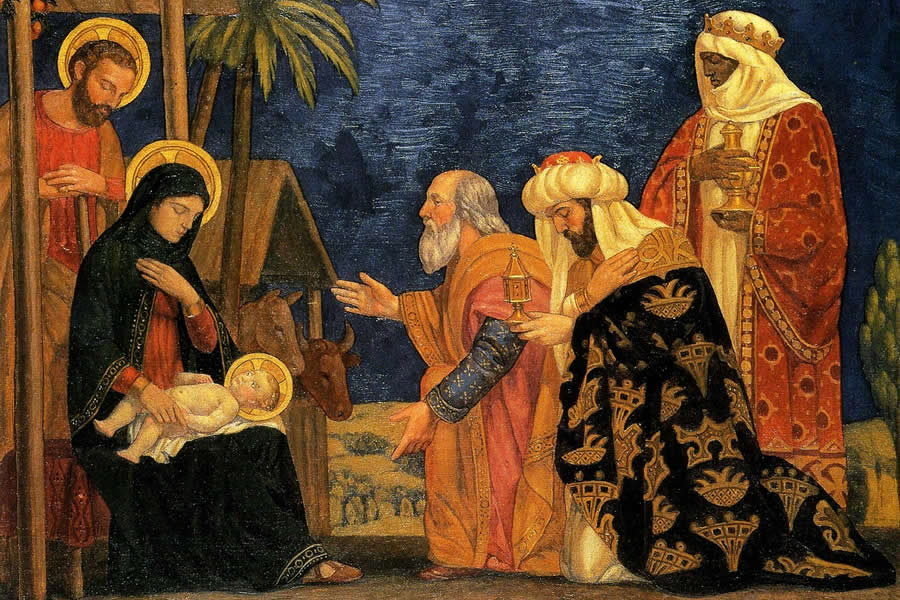
On this great feast of the Lord's Epiphany we are blessed to be given a second blast of Christmas joy as we recall the exotic visitors - these Magi from the east who traveled by night in search of a newborn king. They are only mentioned in Matthew's gospel with very little information as to their whereabouts, their number and their ultimate purpose in searching for this king. In Christian imagination and artwork there are three Magi depicted, frequently portrayed as royal figures.
They were most likely astrologers, fortune tellers, or those who practiced the magical arts. The lavish gifts which they presented to the child Jesus have been given symbolic meanings intended to identify the significance of Jesus, i.e. gold to represent his kingship, frankincense (used in worship) as a sign of his divinity, and myrrh, a burial ointment to foreshadow the child's death. Over time the Magi were named Gaspar, Melchior and Balthazar. Nothing is said of their mode of transportation, but a logical assumption is that they came by camels or horses that allowed them to traverse, swiftly over the treacherous terrain of the desert.
Some scholars have suggested that they may have come from Persia or another neighboring country and that the journey upon which they embarked could have taken two years to complete. If this were so, they would certainly not have encountered Jesus in the Bethlehem manger but instead at his home in Nazareth. An interesting fact is that two cathedrals in Europe claim to house the relics of their heads -- Cologne and Milan. Does this mean that there were six Magi or were the original three two headed aliens from another world? Ha ha.
The Epiphany's touchstone text is contained in Matthew's gospel. Its meager details and the scarcity of historical data enabled it to be a story from which legends and creative interpretations emerged over the centuries. This has given people license to adapt and assimilate its rich drama with its primordial symbols, such as the star, in ways that speak to particular moments in time with the fundamental message of God's universal love.
One such legend was that the three Magi were all different ages. Gaspar was the youngest, Balthazar was in his middle years and Melchior was a senior citizen. When they came to the cave of Bethlehem they each went in separately. The elder Melchior went in first and found an old man like himself with whom he felt very much at home as they spoke about memories and gratitude. The middle-aged Balthazar followed and encountered a teacher of his own age. They conversed about leadership and responsibility. When Gaspar entered, he was met by a young prophet who spoke to him about the need for reform and promise.
After they had their meeting, they stood outside the cave and marveled among themselves as to how each had gone in to see a newborn baby but instead met someone his own age. Then together they entered the cave a second time each carrying his gift. This time they saw a child twelve days old laying in a manger on a bed of straw. The meaning of the story is that Christ speaks to people at every stage of life. To the elderly he speaks of integrity and wisdom. To the middle-aged he speaks of generativity and responsibility. To the young, he offers a message of identity and intimacy. (This version of the Epiphany story was taken from Starlight: Beholding the Christmas Miracle All Year Long by John Shea.)
What this rendition of the Epiphany narrative demonstrates is how uniquely it has been interpreted as a catechetical tool. Its flexibility and open structure allow for this application which is but one example of how it has served Christians time again.
The following poem written by the Trappist monk, Thomas Merton, is not necessarily a new interpretation of Epiphany. It does, however, invite the reader to ponder and unpack the time-honored images that are associated with both Christmas and Epiphany. Its full effect can be experienced if read slowly and multiple times thus allowing it to touch our religious imaginations with its gentle power.
Carol
Flocks feed by darkness with a noise of whispers,
In the dry grass of pastures,
And lull the solemn night with their weak bells.
The little towns upon the rocky hills
Look down as meek as children:
Because they have seen come this holy time.
God's glory, now, is kindled gentler than low candlelight
Under the rafters of a barn: Eternal Peace is sleeping in the hay,
And Wisdom's born in secret in a straw-roofed stable.
And O! Make holy music in the stars, you happy angels.
You shepherds, gather on the hill.
Look up, you timid flocks, where the three kings
Are coming through the wintry trees;
While we unnumbered children of the wicked centuries
Come after with our penances and prayers,
And lay them down in the sweet-smelling hay
Beside the wise men's golden jars.
Blessings,
Fr. Gabriel O. S. B.
BACK TO LIST