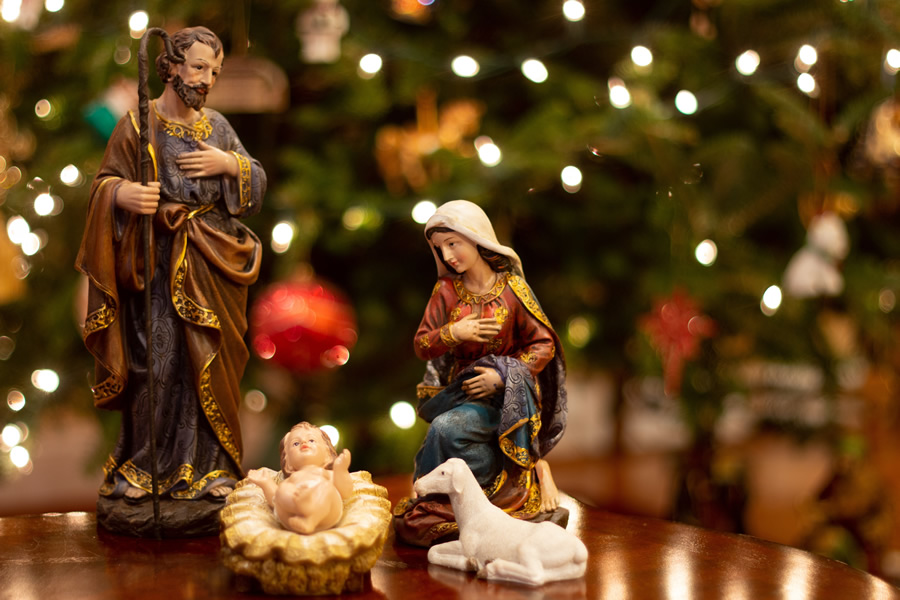
Merry Christmas
by Rev. Gabriel Baltes, O.S.B. | 12/28/2025 | Weekly ReflectionDear Parishioners,
In his poem, "The Silent Seers," J. Barrie Shepherd reflects on the stable of Bethlehem and who, among those present there, really knew what's going on.
Of all the witnesses around the holy manger perhaps it was the animals saw best what lay ahead for they had paced the aching roads slept in the wet and hungry fields known the sharp sting of sticks and thorns and curses endured the constant bruise of burdens not their own the tendency of men to use and then discard rather than meet and pay the debt of gratitude. For them the future also held the knacker's rope, the flayer's blade the tearing of the bodies for the spring of a race. In the shadows of that stable might it be his warmest welcome lay within their quiet comprehending gaze?
The poem's dark rhetoric may at first seem strange, if not inappropriate, for the subject matter of Jesus' birth. The recurring images of brutal, painful treatment, not uncommon to farm animals, are meant to foreshadow the passion of Jesus in his adult life. As such, these creatures have a natural bond with the child who was laid in a manger and who will be nailed to a cross. The wood of the crib will become the wood of the cross.
Attaching suffering and death to the birth of God's Son is, in no way, intended to dampen the joy of Christmas and replace it with a penitential, macabre tone. Rather, it is meant to underscore the Christian conviction that in the Incarnation of the Lord Jesus, there is the total union of divinity and humanity, for what is more human than death? It was the fact that the eternal Son of God took on our human nature in its totality that brought salvation to the world. If Jesus had only appeared to be human and not destined for death like all other mortal beings, his becoming flesh would have been incomplete. It would be equally false (i.e., heretical) to claim that Jesus was not fully divine that is, co-eternal with the Father.
There is an enchanting legend that in 325 A.D., at the Council of Nicaea when the identity of Jesus was formally defined, the heretic Bishop Arius publicly asserted that Jesus Christ was not eternally God. At this bold and erroneous declaration another bishop whom we know as the beloved St. Nicholas of Myra, rushed up and slapped Arius in the face. (This may be the reason that he later became the patron saint of boxers.) The council fathers would not tolerate Nicholas' violent behavior and so had him put in jail. That night however, the Virgin Mary is said to have appeared in his cell and freed him because she, of all people, knew the true nature of the one she gave birth to.
Our belief in the Incarnation - Jesus as fully human and fully divine, is the heart of our Christmas celebration. It calls forth wonder from us as we make our way through the journey of life. Jacob Niles captured this in his familiar Christmas song:
I wonder as I wander out under the sky,
How Jesus the Savior did come for to die,
For poor lonely people like you and like I,
I wonder as I wander out under the sky.
As we gather during this Christmas season with family and friends we might remember those loved ones who have preceded us in death. The eternal life to which they are welcomed is God's gift - a gift given because God's Son took on the fullness of our humanity which inevitably included death. The theological phrase that summarizes this sacred reality is: "God became human so that humans might become God." Is it any wonder that even the angels rejoice with us now as they did in Bethlehem of Judaea on that first Christmas night!
Christmas blessings,
Fr. Gabriel O.S.B.
BACK TO LIST