The 3 Strains of Celebration
by Rev. Gabriel Baltes, O.S.B. | 11/30/2025 | Weekly ReflectionDear Parishioners,
Once again, we find ourselves immersed in, what many (including myself) describe as, "the most wonderful time of the year." I believe this description is justified given the level of joyful energy and hopeful activity in which so much of our culture is engaged. Though we may find ourselves emotionally drained and physically exhausted when this holiday season is over, I suspect most people are happily excited when it rolls around each year.
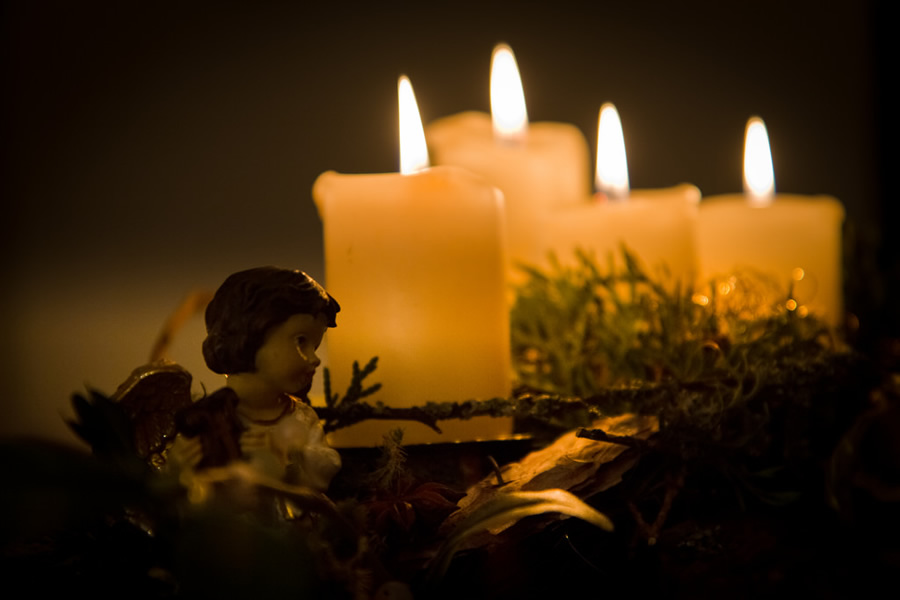
For us Catholics living in the Northern Hemisphere, I see three distinct strains of celebration that merge together at this time of year. The first is the celebration of winter. This is a seasonal given and non-denominational factor that some find intimidating and inconvenient due to the snow, ice and cold, all of which can become dangerously extreme posing serious hazards. I find that most people still find a beautiful dimension to the uniqueness of winter weather. As an expres- sion of hopeful endurance during these cold dark days, it has been customary, since pagan times, to festoon homes and public places with evergreen boughs that retain their greenness while all other trees give up their leaves. Light, whether given off by candles or electrical fixtures, has also been a significant symbol that finds multiple forms of expression in wintertime.
Joining the celebration of winter is a second strain that I refer to as the "Secular Christmas." This should not be taken in a derogatory manner. Secular Christmas is the glitzy, commercial and fun-loving side of the season. It involves features like: colorful decorations, time honored practices, culturally distinct foods and gatherings with family and friends to exchange gifts. There may or may not be a religious tone in all of this, nor does there need to be. While I certainly do not oppose the notion of "keeping Christ in Christmas," it should be remembered that Christians co-opted an already existing celebration of the Winter Solstice in the 4h century when they assigned the birth of Jesus to December 25. To a great extent therefore, they gave up the right to dictate how the culture should observe this holiday. In many ways, the culture with all its commerce and public activities, is what kept Christmas so popular and widely celebrated. I fear that if Christmas, as the celebration of Jesus' birth, had remained in church circles alone, it may have gone the way of the holydays which are given minimal attention in most people's lives.
This brings us to the third strain of Christmas which is the religious celebration of the Nativity of Jesus. While the "Secular Christmas" described above begins shortly after Halloween and concludes on or around January 1, "Religious Christmas" begins on December 24 and concludes on January 6, the feast of the Epiphany, or (in the Catholic tradition) on the feast of the Baptism of the Lord which is a movable celebration from year to year. "Religious Christmas" is preceded by the lovely Season of Advent, roughly about four weeks before December 25. Advent's focus is twofold. The first is on the Second Coming of Jesus - his return in glory at the end of time, and is a hallmark of the early days of Advent. In the latter days of Advent, especially from December 17-24, the focus shifts to the historical coming of Jesus - the Word made flesh.
As the season of Advent unfolds it takes on a crescendo-like quality that permeates the liturgy while stirring the hearts of those who observe it. It also brings forth from the treasury of the Bible many of the ancient symbols and prophecies that foretold the coming of the Messiah. These are rich in meaning providing an abundance of spiritual food for one's spiritual imaginations.
While I definitely believe that all three strains of the Holiday/Christmas season can and should co-exist, there is a certain tension in doing so. Though it is desirable to maintain the distinction of each strain, this is sometimes easier said than done. For example, it is thematically awkward to sing the beloved Advent hymn "O Come, O Come Emmanuel", that captures a mood of longing and expectation for something to happen in the future, and at the same time sing the exuberant "Joy to the World" that rhapsodizes about something that has already happened in the past, namely that "the Lord has come." Perhaps this is a healthy tension however, and is one of those characteristics that makes this time of year so very sacred bringing us to an awareness that life may not be as neatly compartmentalized between religious and secular as we once thought. However we choose to celebrate this time of year, may it be a transformative time that draws us closer to God and to one another.
The following words of St. John Newman, a recently acclaimed doctor of the Church, may help to link some of the Advent themes and images that are the prelude to Christmas.
THEY watch for Christ
who are sensitive, eager, apprehensive in mind,
who are awake, alive, quick-sighted, zealous in honoring him, who look for him in all that happens, and
who would not be surprised,
who would not be over-agitated or overwhelmed,
if they found that he was coming at once ...
THIS then is to watch:
to be detached from what is present, and
to live in what is unseen;
to live in the thought of Christ as he came once,
and as he will come again; to desire his second coming, from our
affectionate and grateful remembrance of his first.
Blessings,
Fr. Gabriel O.S.B.
BACK TO LIST