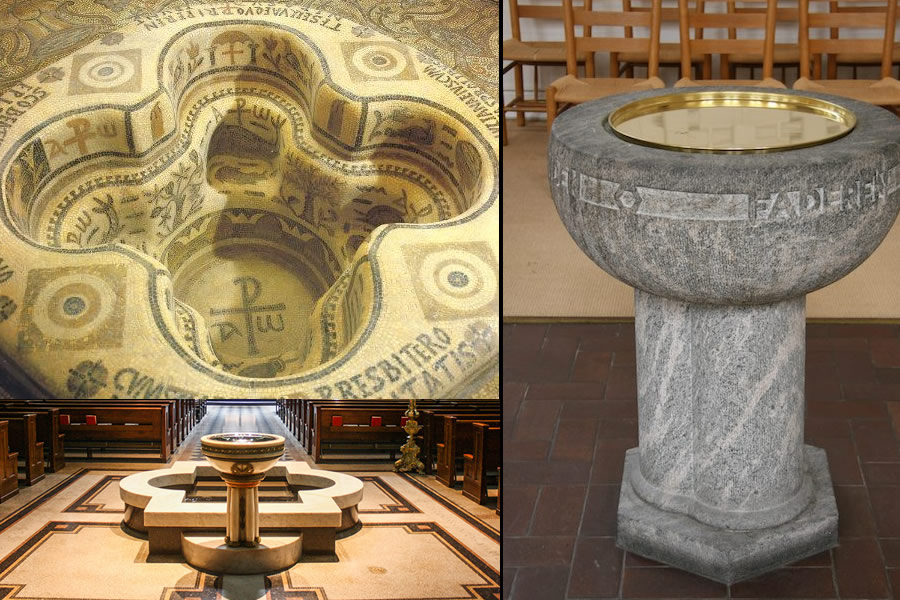
Catholic Church interiors: The Baptismal Font
by Rev. Gabriel Baltes, O.S.B. | 07/21/2024 | Weekly ReflectionDear Parishioners,
As the enhancement of our church interior progresses in a most timely manner, I hope to offer periodic catechetical reflections that focus on various features that are integral, not only to our project here at St. Joan of Arc Parish, but to the general understanding of Roman Catholic liturgical environments. The first focus is on the baptismal font, rightfully called “the womb of the church.” It is from the action at this ritual vessel that people are reborn as Christians. It is important to remember that no one is ever a Christian. Christians are made – they must be reborn into the life of grace. Hence the need for a place where this re-birth may be celebrated in such a manner that recognizes its immense value.
When we first embarked on this parish enhancement project, our plan was to keep the present baptismal font in its current location without altering its design or material. The new terrazzo flooring would extend up to the actual font and surround it on all four sides. After seeing the richness of the terrazzo flooring, I became concerned that the material of the font, which was a low grade imitation marble, might appear less important or less sacred than the floor that would surround it. Unintentionally this could diminish, not only on the significance of the baptismal font, but also the meaning of the sacrament as well. So after consulting with the architect and members of our enhancement project, it was decided to cover the entire font, the exterior and interior, with the same terrazzo product as the floor, albeit with slightly different colors. This would guarantee a lovely harmony with the other construction materials and, most significantly, highlight the dignity of baptism as the foundational sacrament of Christian initiation.
The history of Christian baptism is rooted in the water rituals of Judaism and other ancient near eastern religions. The theological emphasis of these non-Christian rituals was on cleansing and purification after a period of being ritually impure, as for example, a woman who recently experienced her monthly menstruation or who had given birth. John the Baptist be-came famous for employing a water rite of purification and cleansing by immersing his followers in the Jordan River as public sign of their repentance and their desire to embrace a new way of life. We know from all four gospels that Jesus himself submitted to the baptism of John, even though John initially resisted Jesus’ request. Jesus sought John’s baptism however, not because he was steeped in sin and required cleansing and repentance, but because he wished to publicly demonstrate his full immersion into the life of sinful humanity. Christ gained for us our salvation by becoming like us in all things but sin.
While the ritual form of Christian baptism was (is) the water rite inherited from Judaism or other ancient cults, its theological meaning for Christians was (is) significantly different and multivalent. For Christians baptism is always administered by another person. No one ever baptizes him/herself. The formula used in administering the baptism has traditionally been, “I baptize you in the name of the Father, and of the Son, and of the Holy Spirit.” This Trinitarian formula, uttered with this exact sameness, is required for the validity of the baptism.
Within the New Testament there are five major metaphors that unpack the theological meaning of baptism. The first and most dominant is union with Jesus Christ. St. Paul states, that when were baptized into union with Christ Jesus, we were baptized into his death. We were buried with him and lay dead, in order that as Christ was raised from the dead by the glory of the Father, so we also might set our feet upon the new life of Christ. For if we have been incorporated with him in a death like his, we shall also be one with him in his resurrection (Rom. 6: 3-5) This interpretation led the early Christians to design baptismal fonts that were pools of water into which the candidate could be fully plunged, usually naked, 3x. The font was likened to a watery grave in which the individual died with Christ and rose with by going down under the water and rising from it. The second theme for baptism was incorporation into the church. St. Paul says, we were all brought into one body through baptism, in the one spirit. (1Cor 12:13) This emphasized the equality of all the baptized – no Jew of Greek, slave of free, male or female. All are one person in Jesus Christ. (Gal 3:27-28) This understanding led church architects to locate the baptismal fonts near the doors of entry of the church building. If baptism brings one into the mystical body of Christ’s church, it was logical to place the font as the very point of entry.
The third metaphor for baptism is new birth. This image appears in the teaching of Jesus to Nicodemus No one can enter the kingdom without being born from water and the spirit. (John 3:5) Implicit in this notion is the claim that the baptized person becomes a new creature who has put aside his/her former way of life. Here the baptismal font is both womb and tomb. This is why in the early centuries, part of the baptismal rite of the removal of all clothes and jewelry so that the candidates were baptized in the nude. They were, in a spiritual sense, putting off the old man/woman so that they could put on Christ. This new life was then symbolized by covering the newly baptized in a long white garment which they wore for the entire week after baptism. This theology of becoming a new creature also inspired liturgical architects to design fonts that were enshrined in eight sided chapels, apart from the main body of the church. The number 8 was an eschatological number that symbolized the 8th day of creation – the new creation – one better than 7. Thus the newly baptized is brought to the threshold of heaven.
A fourth teaching about baptism is that it is the removal or forgiveness of sin. This notion compliments some of the ideas inherent in the preaching of John the Baptist. Water, which is a natural cleansing agent, can easily symbolize the interior cleansing expected of the followers. Later, especially with the teaching of St. Augustine, this cleansing will be the removal of original sin that each person comes into the world bearing. But notice the little emphasize this idea received compared to the other biblical themes. And yet for centuries this became the dominant metaphor in Roman Catholicism urging parents to have their children baptized as soon as possible. With the vast number of infant baptisms that will now be celebrated in the church, baptismal fonts became quite small, usually a basin on a pedestal looking more like a birdbath than a watery grave.
And finally, the fifth noteworthy metaphor for baptism is the reception of the Holy Spirit – …and you will receive the gift of the Holy Spirit. (Act 2:38) It was understood that by being a member of Christ’s body, one also received the Holy Spirit. The anointing with the oil of Chrism after the baptismal washing, symbolized this glistening presence of God’s Spirit that was lavishly bestowed upon the newly baptized.
With the symbolic and theological richness contained in the Sacrament of Baptism, it becomes apparent why a baptismal font, in any Christian church, should be one of its most sacred and impressive appointments.
BACK TO LIST