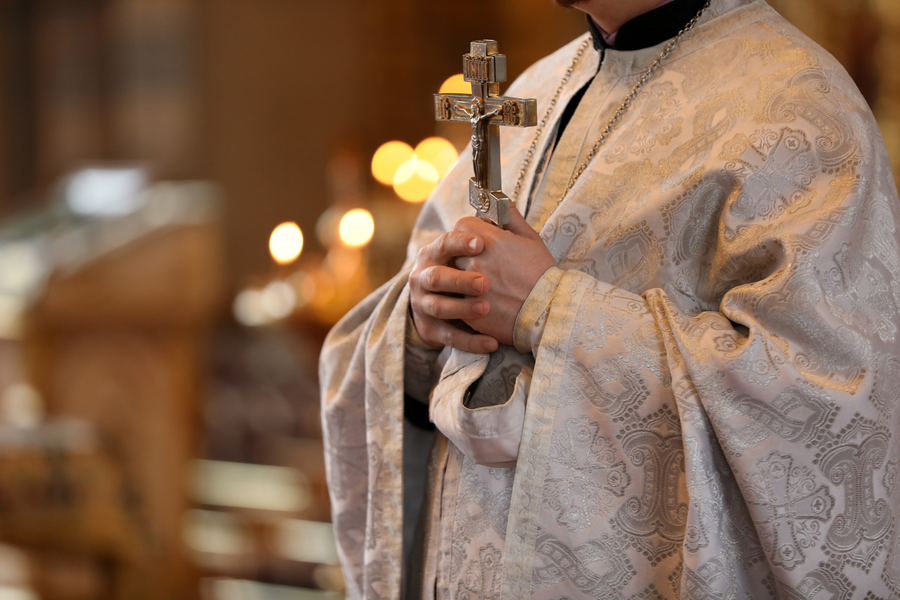
Vesture
by Fr. Gabriel, O.S.B. | 06/07/2026 | Weekly ReflectionDear Parishioners,
In the previous weeks, I reflected on the major liturgical gestures that are organic to the Eucharistic Liturgy in the Roman Rite. I tried to explain their historical origin, how they evolved over the centuries, and what they are attempting to express as a bodily language that is an essential element in our embodied worship as Catholics. Today I wish to reflect on yet another aspect of worship, namely vesture.
Like gesture, vesture is not a phenomenon that is unique to religious activities, but is a time-honored component to many secular rituals as well. When referring to vesture in this context, it is intended to include any attire or costume that is regularly worn for specific functions and by specific people. It serves to identify not only the individuals who wear this clothing but sets apart the event or activity in which it is worn. It gives these events a prominence as it engages our sense of sight. Like gestures, vesture is a language unto itself.
Because Christianity was illegal throughout the Roman Empire for its first 300 years (it was legalized by the Emperor Constantine in 313 AD), Christians did not incorporate any distinct garb during their worship. They avoided any external trappings that might draw attention to themselves or the activities they were engaged in. The Liturgy was kept simple and unadorned because the main challenge in these early centuries was basically to survive. After 313, with the “Edict of Toleration”, Christians could emerge from hiding and publicly identify themselves as followers of Jesus Christ. This was true of their worship as well. In addition to sanctioning the Christian faith, the emperor bestowed various privileges on the church, for example, the right to assemble in public buildings, which were called “basilicas.” Members of the church were permitted to hold public processions through which they gave witness to their faith. In these processions, the bishops and the pope were entitled to be carried on a chair, like an emperor. They had the right to be flanked by lit torches and preceded by incense as well as their official standard, which was the cross typically ornamented with precious jewels and void of an image of Christ crucified.
It was during this period of “imperialization” that distinct clothing began to be used by the clergy. Initially, this clothing was the ordinary dress of Roman citizens, but of a special quality. The fundamental garment worn was the alb, from the Latin word alba meaning “white.” As its name suggests, it was a white ankle-length robe worn by free men and women. A white alb was eventually bestowed on all Christians during the baptismal rite to symbolize youthfulness, purity, and immortality. Over the alb was worn an outer garment known as a paenula. It was essentially a coat worn outside as protection from the elements. Later this will be called the chasuble.
Following the alb and chasuble, other types of vesture will get adopted into the church’s liturgical wardrobe. Unlike the alb and chasuble, which were common clothing of the time, this second category of vesture consisted of insignia that identified distinction and separateness. For example, the stole, which was a long, narrow band of cloth worn around the neck hanging down in front of the alb, became a garment worn by bishops, priests, and eventually deacons, the latter of whom wore it over the right shoulder and across the chest. Previously, the stole was a juridical garment worn by magistrates and judges to symbolize their authority and power. It may also have derived from a napkin-like cloth worn over the arm by those who waited on tables during banquets. Later this will morph into the maniple which was regularly worn by priests and bishops during the Mass.
Other insignia that became vesture gets adopted by bishops and popes in particular. Examples of these are: the Pallium, which consisted of two white narrow strips of woolen cloth which were sewed to a circular band of the same cloth that go over the head of a bishop who has jurisdiction over several dioceses. It evokes the image of a yoke and highlights the bishop’s role as a shepherd. Today, this vestment is worn by the pope and archbishops only within the territory entrusted to their care. The mitre, a pointed head covering, was taken over by bishops, abbots, and other prelates. Along with the mitre, a crozier, reminiscent of a shepherd’s staff, became a significant feature in the vesture of these ecclesiastical figures, reminding them to be good shepherds in imitation of Jesus.
Other vestments that evolved over time were the cope and humeral veil. The cope was the original chasuble worn by priests and bishops that was fully open in the front and fastened by a clasp near the neck. In appearance, it resembles a cape and is typically worn for processions and liturgical rites other than a Mass. Over the cope is worn the humeral veil, which is similar in design to the Jewish prayer shawl or tallit. Its name is derived from the fact that it is worn over a minister’s shoulders, covering the humerus bone in the upper part of the body. It is only worn when bishops, priests, or deacons solemnly carry the Blessed Sacrament or lift the monstrance to offer a Eucharistic Benediction.
These are the most commonly worn vestments that continue to be used in contemporary Catholic worship. In next week’s bulletin, I will further unpack their use and design.
BACK TO LIST